Showing posts with label Two Hearts. Show all posts

Monday, July 7, 2014

Kdrama Review: Rebirth - Next (2005)


Rebirth - Next
환생-넥스트 
7/10 ♥♥

Drama watchers rejoice: it's the review you've all been waiting for! No, it's not, and actually you've probably never heard of this whimsically romantic drama before, but that's okay. I'm here to change that. Rebirth, Next, Reincarnation, whatever you want to call it, is actually five stories about the same four people who meet in the present, and in four different pasts. Each time they're reincarnated (in four conveniently romantic historical Korean eras) their lives are plunged into chaos and angst, into brilliantly reworked and unique love squares, and when they die they don't remember each other in the next life. Or do they?

There is an overarching story set in the present timeline, which weaves in and between the historical eras, and that story is probably the wildest of them all. It's where we meet our main characters for the first time though. Ryu Soo Young is the neurosurgeon Min Ki Bum; Jang Shin Young plays Kang Jung Hwa, a starving stage actress; Lee Jong Soo is her colleague and almost boyfriend Min Ki Soo; and Park Ye Jin is the psychologist Lee So Hyeon who begins treating Jung Hwa with hypnosis, while possibly revealing their intertwining pasts.

Rebirth - Next is cheesy, epic, romantic to a fault, and great for those rainy days when you just want to whine about love and be overly indulged. And here's the best part. Once you've watched it through, you don't need to rewatch the whole thing. Just pick which era and storyline you liked in particular, and that two-episode era will be quite enough to fullfill all your nostalgic wants. Confused? Follow my guide with accompanying non-spoilery descriptions below.


Wednesday, February 26, 2014

Kdrama Review: Que Sera, Sera (2007)


Que Sera, Sera
케세라, 세라
8/10
 
♥♥

My tastes in dramas have surely been wandering. I can't keep up with the hype of modern dramas, and while 2007 isn't technically that long ago, for a Kdrama there's a world of difference between this dark melo of the past and the world of today's trendies, including some of the more recent melodramas I've been able to sit through. So while everything I tend to start these days ends up perpetually 'on hold', something about watching this class act from the not so distant past took me back to the days when I had just discovered Kdramas - when every thing was new and wondrous, when dramas could shock me. Unlike my encounters with the first Kdramas of personal experience though, this one even made me a little bit scared.

Que Sera, Sera is sometimes listed as having one of the darkest, twisted plots you can find. Let me tell you something: it fits the bill. Okay maybe not as far as totally sicko, disgusting, or morbid. There's no gore or psycho killers. But there's no villain! And that's kind of the whole point. Our lead man Kang Tae Joon, played by Shinhwa's Eric Moon, is poor. Our lead girl Eun Su (Jung Yu Mi) is also.. get this.. poor. The second leads are not-exactly-siblings Ji Soo and Joon Hyuk (Lee Eun Soon and Lee Kyu Han respectively), the richer duo, and not a single person in this whole drama is happy.  Poor man falls in love with poor girl, but dates rich girl so he can take care of poor girl's debts. Rich girl gets a fake boyfriend to taunt her not-a-brother former lover, and not-brother genuinely falls in love with poor girl. Seemingly standard fare except the cross mixing of these four's relationships with one another are simultaneously exhilarating, and downright disturbing.

Here's just one small reaction hint: It's a kiss scene. Our girl is running out of a hotel room in the rain, trailed by hot Eric Moon who spins her around violently, and she gives in initiating steamy smooching.. I'm sitting on the floor in front of the TV while all this is happening, and my husband just comes in from work through the front door. He finds me, Rosie, sitting stunned, hands covering my mouth. "Good scene?" he asks with a mistakenly placed smirk. "No!" I answer with a horrendous squawk and burst into tears of rage over the events on screen. When did ever a kiss scene go wrong? You'll find out when you watch Que Sera, Sera.


I still have nightmares.

Note to readers - This drama is kind of amazing. Sure it's old and the cinematography and production values are a bit lacking. The second girl a plastic nose identical to a dozen other same era actresses, and every character in the show will at some point make you want to rip your hair out - except where in most Kdramas where it's cliches and crappy plot twists or character non-development that make you want to end your life, here it's because Que Sera Sera has a raw edge to it that I've rarely seen even in the movies, let alone television. And whether or not you like the characters, the actors' portrayals sell the whole thing, and it's impossible to quit and not wonder what on earth is going to happen to them all.

Read for more some SPOILERLY thoughts rambles on the story, the pairings, and the end.


Saturday, December 28, 2013

Jdrama Review: Last Friends (2008)


Last Friends
ラスト・フレンズ
8/10 
♥♥

There are days where I'm in the mood to watch something absolutely miserable, where I need to put the woes of my life into deep perspective and focus on other peoples' fictional problems - and sit in wonder that there are actually people in this world whose lives do mirror what I see onscreen. Then I cry and sob for a good while, stifle the urge to throw something, and reinforce my willingness to keep watching. Why? Because in adversity, people shine through. Or they are vanquished, and I wasn't certain what the result would be for these last of friends.


The Cast

In a role that will absolutely terrify you, Nishikido Ryo is Sosuke, by day a child welfare social worker, by night an attentive boyfriend - and by attentive we mean the emotionally and physically abusive kind of boyfriend. Nagasawa Masami plays Michiru, a girl victimized not just by her boyfriend but also by a childhood worldview she believes in where life is cruel and you just have to get used to it. Enter a cluster of friends old and new to her rescue, including Ruka (Ueno Juri), a motor-cross racer devoted to Michuru's protection; and Takeru (Eita), a hair stylist and kind friend, with a deeply troubling past.


Creeper Alert.
At its ugliest, Last Friends explores the day to day consequences and psychological effects of domestic violence, gender identity crisis, and sexual abuse. "Lesser" hit topics include suicide, adultery, and plain old sexual harassment. Could this drama have been any more emotionally involving? It's from Japan- in a society that apparently doesn't care to whitewash such issues on national television. More power to them because, Last Friends is a hard-hitting depiction of equally traumatizing existences; more importantly though- how the relationships of its characters are pulled to and fro, towards the light and back towards the darkness. 

Best of friends?

Is it Watchable? 


YES. Because unlike other misery-laden dramas I've had the misfortune to sit through (both Korean and Japanese), Last Friends deals with this horror in a fashion more situated to real life than dramaland-ish antics. Bad things don't just happen for the sake of it, to the point where you sit around imagining a writers' brainstorming session: "And what shocking plot device should we insert in this week's episode?" Instead, we see our characters reacting is familiar, humanly ways. It's that much more stressful because of this fact - but not every battered girlfriend makes one clean dramatic break, without ever falling and returning to the scene of abuse; deep revelations between friends don't always make everything right; and not every person can completely overcome childhood trauma. Which makes their compromises ever more understandable, and their friendship that much stronger for it. 

Bonus points because after Ryo scarred me for life, I still understood his character. Try making that happen again, dramaland. I'm going to go now and pick out a nice bubbly drama of his to make me forget it ever happened.  

More up on Last Friends, the strength and bonds of friendship, and a how a home sets the difference. No Spoilers

Thursday, August 15, 2013

Un-reviewable Dramas 4: I Hear Your Voice and Monstar

Today's dramas aren't un-reviewable because I didn't like them.  On the contrary, I enjoyed I Hear Your Voice and Monstar immensely, probably because I live-watched both and they fit my weekly heart-racing quota of intoxicating thiller romance and homey school-age romance respectively.

Truth is though, without the romance and the eye candy, these dramas would've been nothing to me. I found that out when I tried to write a full review of I Hear Your Voice and realized I had nothing to say. "Cute characters, great romance, lagging plot devices, melo and comical all rolled into one."  There's only so many times I can repeat the same cliche phrases before I get annoyed at my own prose.


Don't give me that look, Jong Suk - you know I still love you for your acting skills!

I also dislike reviewing dramas right after air because A- Everyone's talking about them and I'm usually ready to put a drama to rest after so much time, or B- Sometimes dramas hit me differently after I've let them sit for a while. Either I'll change a rating or general opinion, for better or worse. Because sometimes it's posterity that determines which dramas we remember, which we love, and which we never want to see or hear of again. I suspect that in time one of these dramas will drop a point in my ranking factor, and the other will rise when I start to get nostalgic, but for now I'll stick with my 8s and move on to the 'review'.

Not to be forgotten, I bring you: I Hear Your Voice (2013) and Monstar (2013). 


Thursday, June 20, 2013

Jdrama Review: Bara no nai Hanaya (2008)


Bara no nai Hanaya
薔薇のない花屋
8/10  
♥♥ 

Need a shockingly good, slightly melo-ish but mostly heartwarming slice-of-life Jdrama with an excellent cast, beautiful and deep characters, that doesn’t feel like work to watch, but still keeps your interest? Can I come up with a longer sentence to describe how gorgeous this drama is inside and out? (Given another 5 minutes, I could probably achieve that.) If your answer is yes, then please do sit down and watch Bara no nai Hanaya, or The Flower Shop Without Roses.

SMAP’s Katori Shingo is single dad Shiomi Eiji who earns a meager living from his small flower shop. When he meets a blind customer Shirata Mio, played by Takeuchi Yuko (Pride), it’s obvious that these two need each other. With a hodgepodge cast of characters, including Shiomi’s young daughter Shizuku (Yagi Yuki) and misfit ruffian Kudo Naoya (Matsuda Shota), it seems evident that all are destined to become one happy family unit for each other. Except more lies under the surface than can ever be seen.

Bara no nai Hanaya is such a lovely atmospheric drama, featuring real and recognizable human beings. Eiji is a simple man with a hidden past, and Katori absolutely does not overact in his characterization. He is slow and plodding, and of the kindest, most selfless creatures you’ll ever see. Yet the drama weaves his past in such a way that the slow unveiling of his life history and the history of the woman he loved is almost as integral to the story as the events that happen in real time. Throw in his obvious affection for Shizuku, and their own adoption of a neighborly grandmother, another loner desperate to feel needed and loved, and just try not having any feels for this beautiful little family structure. 


"O Hanaya-san?"


Keep in mind, all this is even before the lovely Mio steps into their lives, cane in hand, full of anxiety and uncertainty about this new direction in her life. And maybe just a few secrets of her own, hidden behind a web of lies. And perhaps she’s not the only character to have more than one secret.

Read more for some SPOILERY thoughts on the inner workings of this drama. 


Tuesday, April 2, 2013

Jdrama Review: Majo no Jouken (1999)


Majo no Jouken 
魔女の条件 
8/10 ♥♥

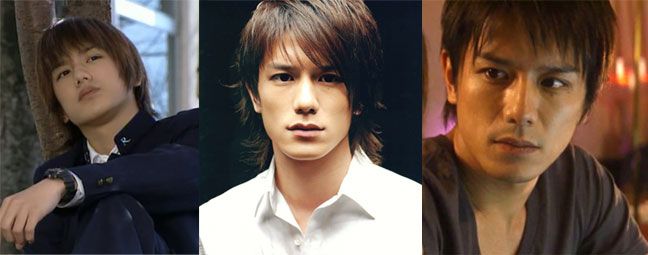
Prepare yourself for a ridiculously young Takizawa Hideaki. I’m not kidding. The man I fell in love with in Orthros no Inu was indeed once a baby – 17 at this time playing high school student Kurosawa Hikaru who, falls in love with his homeroom teacher Hirose Michi played by the 26 year old Matsushima Nanako. Is the love returned? Would it be a drama if it wasn’t? 

If you’ve been around Kdramas long enough, you’ll know that younger man/older woman genre dramas are there in plenty. There’s also no lack of on screen student-teacher relationships, whether they’re played up just for added storyline, or if we’re talking about the main OTP. Where Korea fails in its depictions though are in the specific, gritty details. Lots of denial, skirting around the problem, and random time jumps are the norm (Biscuit Teacher Star Candy, Big). Japan spares no details apparently. Majo no Jouken, or Forbidden Love, is a fully fledged love story that jumps right into the story, the romance, and all the icky taboos and consequences. 

In some ways, Majo no Jouken was a predictable roller-coaster ride as the ‘forbidden’ couple struggle to find acceptance in a society that doesn’t legally forbid their love, but certainly doesn’t know how to handle it. However, a variety of side characters add to the battle, including Hirose-sensei’s one time fiancé and Hikaru’s young and possessive single mother. And between these two, we get the feeling that there are some things even sicker and twisted than the relatively innocuous age difference of our show’s main lovers. 


On a Technical Note:

This drama had me asking questions I never thought I'd worry about. The amount of time I spent surfing the internet studying Japanese legal age of consent; wondering if Japan really does consider it a psychological disorder for a woman to love a high school age boy; curiosity if Japan would really go to such lengths to depict one of the creepiest mothers ever before hinted at; confusion as to why I could care so much about a couple that seems so destined to suffer one crisis after another...

All fruitless efforts, really.  Half mushy, half gritty, Majo's romance was a hot whirlwind of a mess, and not afraid of delving into serious life questions.  What does a woman do when her boyfriend is uneducated and unemployed, and how does said boyfriend take care of a woman 9 years his senior? There is no instant maturity, no immediate solutions, and not every expectation will be fulfilled as first it was conceived. Kind of like... life.

I almost find it hard to recommend this, because unless you’re in the mood for a torturous road of almost Kdrama level proportions (though at least not in length), Majo no Jouken is a painful drama to watch. Even the initial sweetness of the romance is very nearly spoiled by a traumatic second half. However, if you love seeing actors portraying their characters well, and those characters being well-handled over the course of the drama, or if you just want to see Tackey back when he was young and adorable (as opposed to the older version which is just plain hot), then I guess you should watch it sometime. ;) And hardships aside, the characters really do make a sweet couple. I say that even remembering just how young he is here. At least that much is quite believable. 


P.S. Tackey getting hotter as the years go by...

Sunday, February 17, 2013

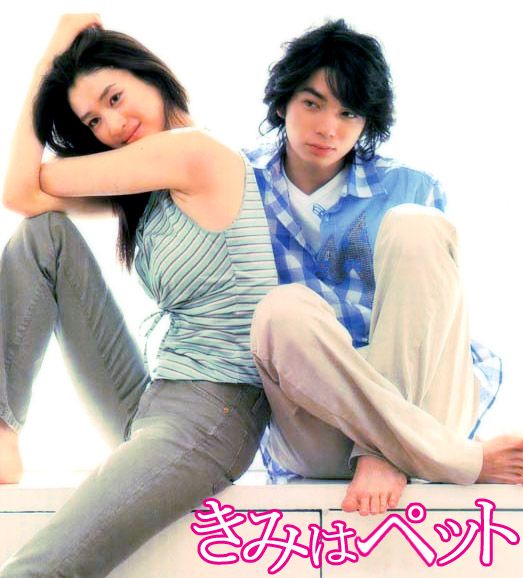
Jdrama Review: Kimi wa Petto (2003)

Kimi wa Petto
きみはペット
8/10 ♥♥

Out of desperation for something to watch, and with the loom of an approaching drama slump (I had just finished watching School), a friend recommended for me Kimi wa Petto. Two minutes later I started it. 24 hours later (after only 3 hours of sleep and a 4 hour work day) I was done. Can we say, most marathonable drama I have watched in months?

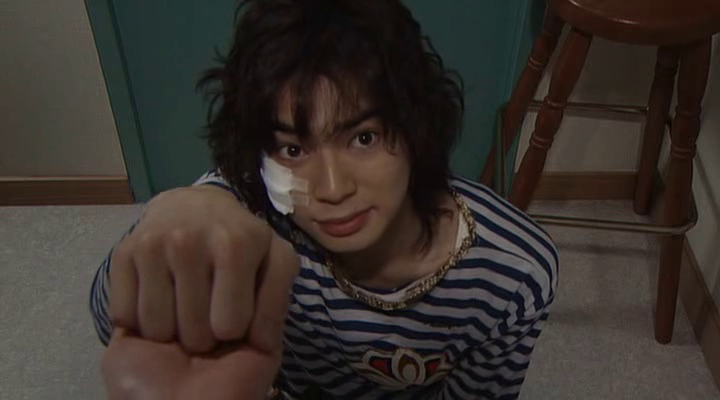
So what’s the story? Girl finds injured boy in a box; girl takes boy home and adopts him – as a dog. I’ll give you a second for your eyes to stop rolling. It works! I promise you, the story actually works! – Once you can get your mind wrapped around the premise that a 28 year old woman would actually be ok taking in a 20 year old homeless boy and in every way possible treating him as a master to its pet. 

Kato Koyuki plays Iwaya Sumire, a career woman so successful that she intimidates all the men around her. Matsumoto Jun is Godo Takeshi, or Momo the obedient dog.  Together they are one of the cutest onscreen couples I’ve ever seen. And when I say cute, I do mean cute as in ‘puppy dog’ cuteness.


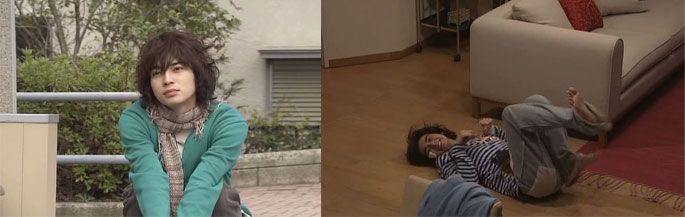
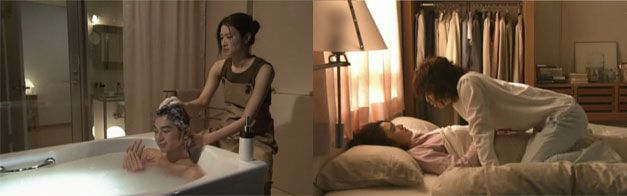
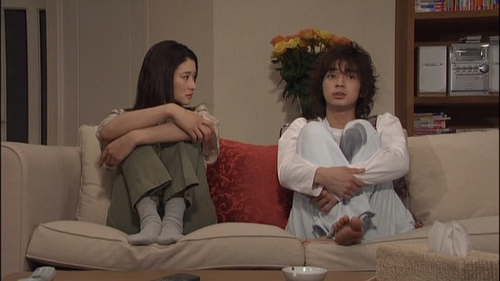
So cute it’s downright awkward:


Yet the strength of the show lies in this very strained and awkward relationship. On one hand, the players are perfectly happy to pretend like it makes sense.  He needs a home and someone to feed him, she’s lonely and likes the companionship, especially at the end of a hard day. To come home from work to find a happy pet waiting anxiously for its owner? Tail wagging, happy and desperately giving out the mixed signals of ‘I love you - Feed me!’ No questions asked, no stressful conversations, and no obligations.

It’s a borderline perfect friendship, laced with a dangerous hint of sexual tension. Especially once Sumire begins an actual dating relationship with another man, and neglects to tell him about the ‘pet’ she keeps at home.  Tanabe Seiichi plays the ideal boyfriend Hasumi Shigehito, tall and even more career bound – perfect for the haughty Sumire whose shorter ex-boyfriend suffered an inferiority complex. Yet the person that begins to melt Sumire’s cold exterior is not the boyfriend she’s crushed on for years, but the warm and huggable stray living away tucked up in her apartment.


In case you’re worried that this isn’t enough conflict already to see this plot through to the end, fear not. Despite the wtf-premise of boy acting like dog, not everything is always fun and games with this couple, nor is the real issue behind their mutual farce completely ignored.  Takeshi/Momo may act like the perfect dog, loving and obedient, but behind the antics is a real human being, sadly cognizant of the reality of the situation. How long can they keep this up and how long he can keep his own feelings hidden drives the plotline of the latter half.  


Do I recommend this? Absolutely. Just shut off your brain for a tiny bit and roll with it.  It’s a unique romance story adapted from a manga – but unlike others of its origin, the drama’s characters are rarely overdone or overly dramatic. Even MatsuJun as the dog exhibits some depths of character as he switches between the happy-go-lucky puppy and the lone artist, dissatisfied with himself and his life.  Kato Koyuki’s Sumire is the real face-palming mystery of the show, unsure of herself and her feelings even as she practically two-times her boyfriend with a dehumanized dog. And yet, her strange behavior could not dampen how fun the drama is overall.  I’m already in a re-watching mood, and at 10 episodes, this seems eminently doable. 

Tuesday, February 12, 2013

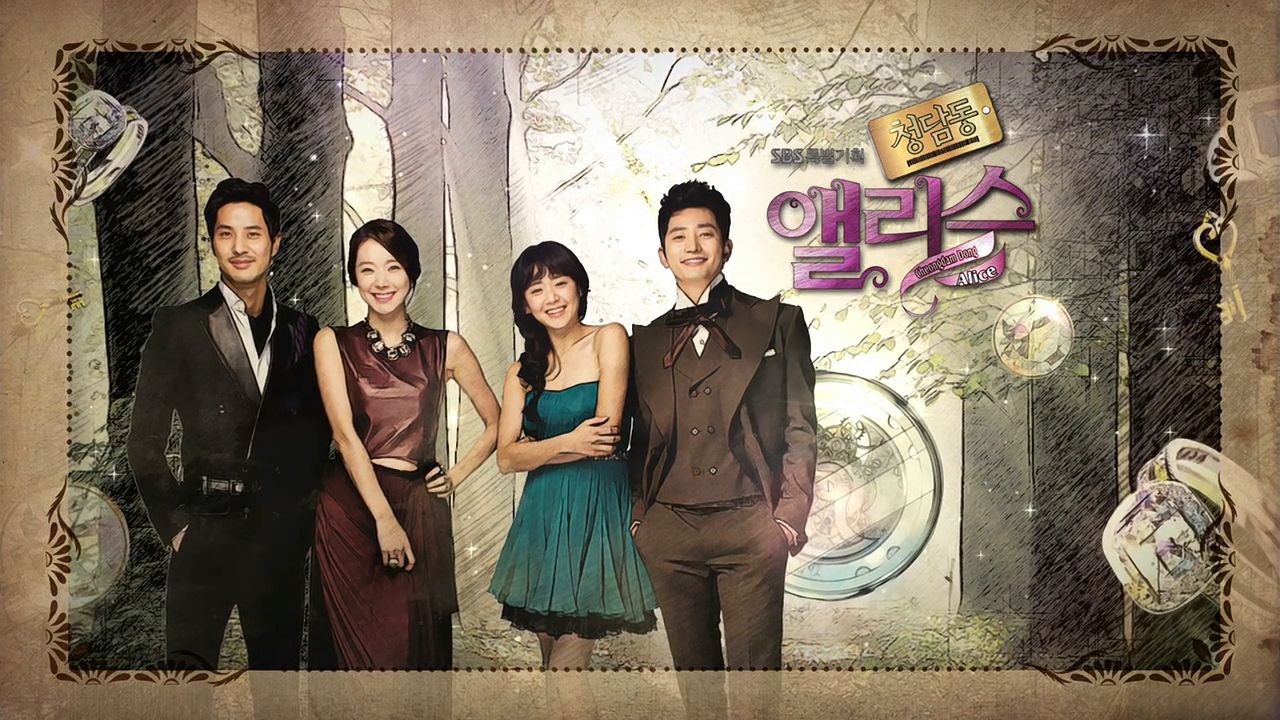
Kdrama Review: Cheongdamdong Alice (2012)


Cheongdamdong Alice
청담동 앨리스
8/10 ♥♥

Get ready for a Park Shi Hoo fest! I’m only half kidding…  Cheongdamdong Alice was one this year’s dramas that I was almost positive I’d be skipping, at least for the currently airing season. Sometimes it’s easier to wait for feedback from the rest of the blogosophere. However, I was more than intrigued after the first couple episodes, thanks in full to the wonderful gif-maker kakashi. Please, see her blog and catch up on the insanity that is Park Shi Hoo acting ridiculous, over and over again in many endlessly entertaining loops. (It was seriously my husband’s favorite thing to do after completing each episode.)

Once started, the first episodes beyond PSH’s craziness were complete snoozers for me. Our main lead girl Han Se Kyung (played by the ever adorable Moon Geun Young) is a fashion designer wannabe struggling to make it in the professional world. She’s got a poor, broke and complete sob-buddy boyfriend (Can You Hear My Heart’s Nam Goong Min), and a crowd of social climber friends urging her to break it off with him and marry a rich man. Enter Park Shi Hoo’s character Cha Seung Jo (or as he likes to be called now, Jean-Thierry). He’s everything a Kdrama lead is supposed to be: rich, rude, rich, president of a fashion company, rich, well-dressed, rude, educated in Europe, and rich. The rest of the drama’s intro is classic and cliché. She mistakes him for a poor secretary, a farce he encourages, and the two fall into step. It’ll soon be love, no doubt.

It’s a story we’ve seen again and again (and I’m about sick of fashion – seriously - I like looking at pretty clothes, but I’m mostly a jeans and T-shirt sort of gal). Somewhere around episode 6 though, I became invested. It hit me so instantly I don’t even remember when it happened. While not everything after that moment was perfect, shockingly this has become one of my more favorite dramas of the season. And because there’s obviously something to this, I think it’s worth a look a few aspects that make Cheongdamdong Alice actually memorable and unique.


Fairytale as Metaphor


This drama certainly isn’t the first to incorporate (or at least reference ad nauseum) a fairytale story (think Secret Garden’s ‘little mermaid’ theme). What’s interesting though is how matter-of-factly the drama takes its Alice character Han Se Kyung.  Se Kyung is the young but not naive girl who finds herself in a the ‘wonderland’ that is Cheongdamdong, a fashionable neighborhood populated by the wealthy and influential, all of whom are probably a little on the ridiculous side (though none so much as the arguably insane Seung Jo). Where the parallel stops though is that Se Kyung doesn’t just haphazardly follow a white rabbit into the hole leading to Cheongdamdong, she actively seeks a white rabbit as someone who will lead her into this new world. Social expert Tommy Hong (Kim Ji Suk) becomes her first target – her goal: an initially nondescript rich husband, and a home and position in Cheongdamdong.

It’s a Cinderella story punctured by one sinister fact: Se Kyung isn’t an innocent damsel in distress waiting to be rescued by her prince charming. As the story progresses, Se Kyung loses more and more of her ‘niceness’ and practically wills herself to become black-hearted for the sake of achieving her goals. She might love Seung Jo, but had he not been a rich chaebol, the story hints that Se Kyung probably would’ve given him up. Her poverty isn’t merely back story. For Se Kyung it is a lifestyle she will give up no matter the costs, and she will give up almost anything to become Seung Jo’s wife, even if it means lying to him, and continuing to lie for the rest of her life.


Se Kyung’s time in Wonderland, however, is forever measured by her continuing successes. One mistake, one fall, and she could find herself back in her poverty-stained reality.  To succeed, she must overcome all the difficulties in her path, particularly those set up by the people who are out to expose her secrets. In relation to the original Alice story, I came across this assessment:  

“The animals of Wonderland are of particular interest, for Alice's relation to them shifts constantly because, as Lovell-Smith states, Alice's changes in size continually reposition her in the food chain, serving as a way to make her acutely aware of the ‘eat or be eaten’ attitude that permeates Wonderland.”

This ‘eat or be eaten’ attitude is especially vital, though perhaps Se Kyung envisions it a little differently: if other people can act like mercenaries, doing whatever they want to achieve or maintain their status, then why can’t she? If they can lie and be backhanded, why shouldn’t she? If she refuses to stick up for herself, unlike heroines in other fairy tale Kdramas, Se Kyung recognizes the possibility of being beaten down, and no one will come to her rescue.  Her journey is marked with highs and lows; sometimes she has the best hand, and sometimes her enemies hold the trump card.


A New Kind of Character


At best, Se Kyung’s blunt and mercenary behavior makes her a unique figure in Dramaland.  At worst, it positions her very close to what the despised second lead character is supposed to act like, and I’m not sure Kdrama watchers are really ready for this kind of development – especially with the ever looming possibility that Park Shi Hoo is going to cry and break the hearts of fangirls everywhere.  Moon Geun Young may receive criticism for her characters’ lack of warmth and ever stony expression; I however believe she acted her part well, consistent to Se Kyung’s emotional hesitancy of becoming the black-hearted gold-digger.

Honorable mention for the twist of character types is So Yi Hyun’s role in Seo Yoon Joo. Initially typecast as the villainous second lead, and first love to Seung Jo, Yoon Joo is actually a forerunner to Se Kyung’s schemes of upward mobility.  Having successfully entered Cheongdamdong, she pities her former school mate and reluctantly aids Se Kyung. They are far from BFFs, but their relationship is every bit as intriguing as the main romance line. As our story progresses, Yoon Joo becomes less and less villainous, and more pitiable. Viewers question her sincerity to help Se Kyung, and wonder at her advice, as every move Yoon Joo makes in her self-imposed Wonderland reveals how hollow her existence is, and how fleeting her happiness may be. Yet, she is a fully fleshed out character, not purely evil nor corrupt, and every bit as relatable near the drama’s end.


Conclusions

I may have painted Cheongdamdong Alice in a rather somber light, but the drama is also hilarious.  Be sure to check out its many comic gems especially in Park Shi Hoo’s zany character, his pricelessly throat-clearing father, every interaction between the main leads’ fathers, Tommy Hong’s ridiculous expressions (not to mention his ‘wtf’ wardrobe), and the great cast of side character friends, all as cute as they are helpful in motivating the OTP.  It’s a cast that adds to the drama more than it detracts, and I can’t often say that about most side characters or second leads. Therefore, thumbs up Alice, and I will miss the time we spent together.

Monday, December 10, 2012

Spring Waltz (2006) - Final Report


Spring Waltz
봄의 왈츠
8/10 ♥♥

For those of you who have been waiting breathless to see if Rosie ever managed to finish watching Spring Waltz, and to find out how my mid-way Endless Love Slump eventually turned out, well you can breathe easily now. I finished, and the midway slump didn’t destroy every bit of my love (though some of it was a little dampened).  Spring Waltz may be the last of the director Yun Seok Ho’s Endless Love, or Four Seasons series, but it finishes first in my book.  How so, you may ask?  Is it radically different from its predecessors? Well, yes and no, and yes.  For clarity, visit the rest of this page and you can check out my very sprawling (and spoilery!) review, character analyses, and topical exchanges.

For those of you haven’t seen this gem however, let me reiterate some of the reasons why I love it, and why of course I think you should see it! Ladies, it’s all about the romance. And Daniel Henney *coughs* Actually, the drama is extremely well done for a slow melodrama, and is absolutely gorgeous to watch.  Don’t be frightened away by the lead’s long shaggy hair. It’s… artistic, and it sways nicely when he plays the piano.  Aesthetics aside, Spring Waltz is actually rather brilliant in its storytelling and character depictions. If you’re looking for a stronger reason to believe in the K-Drama formulas of love and attraction, hate and revenge,  jealousies petty or otherwise, friendship and loyalty, Spring Waltz gives us some of the best motivations for all of these things. While I may have been sickened by some of its characters’ typical Dramaland-ish reactions, you can believe me when I say the drama gives them ample excuse to feel abused.  It’s an emotional roller-coaster for all, yet every plot string is tended with the upmost care.  There is complexity in its simplicity, which for the most part, I thoroughly enjoyed.