Showing posts with label Matsuda Shota. Show all posts

Thursday, June 20, 2013

Jdrama Review: Bara no nai Hanaya (2008)


Bara no nai Hanaya
薔薇のない花屋
8/10  
♥♥ 

Need a shockingly good, slightly melo-ish but mostly heartwarming slice-of-life Jdrama with an excellent cast, beautiful and deep characters, that doesn’t feel like work to watch, but still keeps your interest? Can I come up with a longer sentence to describe how gorgeous this drama is inside and out? (Given another 5 minutes, I could probably achieve that.) If your answer is yes, then please do sit down and watch Bara no nai Hanaya, or The Flower Shop Without Roses.

SMAP’s Katori Shingo is single dad Shiomi Eiji who earns a meager living from his small flower shop. When he meets a blind customer Shirata Mio, played by Takeuchi Yuko (Pride), it’s obvious that these two need each other. With a hodgepodge cast of characters, including Shiomi’s young daughter Shizuku (Yagi Yuki) and misfit ruffian Kudo Naoya (Matsuda Shota), it seems evident that all are destined to become one happy family unit for each other. Except more lies under the surface than can ever be seen.

Bara no nai Hanaya is such a lovely atmospheric drama, featuring real and recognizable human beings. Eiji is a simple man with a hidden past, and Katori absolutely does not overact in his characterization. He is slow and plodding, and of the kindest, most selfless creatures you’ll ever see. Yet the drama weaves his past in such a way that the slow unveiling of his life history and the history of the woman he loved is almost as integral to the story as the events that happen in real time. Throw in his obvious affection for Shizuku, and their own adoption of a neighborly grandmother, another loner desperate to feel needed and loved, and just try not having any feels for this beautiful little family structure. 


"O Hanaya-san?"


Keep in mind, all this is even before the lovely Mio steps into their lives, cane in hand, full of anxiety and uncertainty about this new direction in her life. And maybe just a few secrets of her own, hidden behind a web of lies. And perhaps she’s not the only character to have more than one secret.

Read more for some SPOILERY thoughts on the inner workings of this drama. 


Tuesday, January 22, 2013

Jdrama Review: Liar Game (2007)


Liar Game
ライアーゲーム
7/10 ♥

Well I finally got around to watching what is hailed in some circles as a classic:  Japanese manga adaption Liar Game.  Having heard much about it and its cast, I was no ends of hyped up and ready to go. I got to cracking, and 5 hours later in whirlwind fashion I’d watched nearly half the drama! Then I took a break and watched some more.  I haven’t marathoned something like that in nearly a month (Full House 2 really doesn’t count), so finding a drama so highly marathonable was a treat to behold, but once I stopped – I stopped. And wondered. And pondered. Why it was seemingly addicting, but not perfect. Intriguing, though somewhat lacking. But ultimately, why I couldn’t tear my eyes away from the screen. 

The Plot

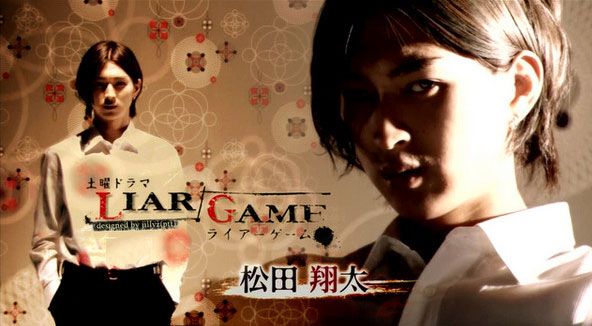
Ignorantly naïve and honest-to-a-fault Kanzaki Nao (played by Toda Erika) is duped into playing a mysteriously organized ‘Liar Game’ after receiving 100 million yen (or $1,000,000), which she must either keep safe from her opponent and his 100 million yen, or steal his to win the game. She is of course dangerously out of her league, until it’s brought to her attention that a former con-man and genius swindler Akiyama Shinichi (played by the gorgeous Matsuda Shota) might be persuaded to help her out.  Enticed with pity, Akiyama teams up with our ridiculously gullible heroine as they are forced to play, and keep playing a series of rounds, each with higher stakes and more cunning, villainous opponents. 

The Cool Part

The games themselves are a logician’s masterwork.  No twist is foreseeable, and no puzzle unsolvable to the brilliantly minded Akiyama-san.  If you like sitting for half an hour – or two - in complete suspense wondering how on earth they will ever manage to win each round through sheer guile, biting your fingernails in anticipation of victory – well that might explain why it’s so highly marathonable.  Matsuda Shota plays his part to perfection as the ultimate silent type: an analyst of humans, ever noting the depths of lies and secrets, and calculating every possible move before it happens. You’ll find yourself sitting in absolutely stillness waiting for his manipulations to become clear and work their magic.

The Boring Part

You get the feeling after a while that Akiyama-san will always be there to save the day. And then, the suspense becomes merely repetitive.  Having watched half the drama, the pattern for each match firmly memorized, and my brain starting to unravel to keep up with each game’s rules and intricacies, I found myself spacing out.  Fortunately, the drama anticipates just such an outcome. Get lost trying to understand the all the players’ plots and maneuverings?  No sweat! Before the game ends, there’ll be at least a 20 minute step by step account of how everything happened, and why.


The Real Crux of the Matter

Games and plotting aside, there’s something very unique about Liar Game’s premise.  The story isn’t merely about forcing poor innocent, indebted people to play a game, practically to the death, financial death.  Liar Game instead strives to uncover the heart of human nature itself.  As the game’s masterful creator intones:  “Humans are willing to betray each other in order to survive.  Therefore, what’s wrong with deceiving others from the start or living faithfully for your own desires? That’s being human.”

 
The world he paints in one of black and white, where the black-hearted will always win, and the weak and pitiful will always lose.  It’s the cunning versus the trusting, and the pack against the loner, not necessarily evil versus good.  To reach the top, humans should or will be capable of stepping on anyone and anything; survival of the smartest, when the risk is losing everything.  You lie or you lose. 


In Kanzaki Nao, we not only have the most gullible and trusting character ever written; she is an allegory of trust and honesty, absolutely incapable of lying. To the exasperation of the Liar Game Tournament office (or perhaps to their increasing interest), Nao refuses to adhere to their rules.  She tries again and again to prove that with teamwork, everyone can win and advance to the next round, maybe not with a profit, but at least debt free. The catch is, if Nao wins, it will disprove everything our Liar Game creator believes in.  But for how long Nao can keep the players working together is the only true unknown. It’s a question not even solved by the end of drama.  Another season and several movie specials follow Season 1. 


Conclusion

I actually managed to improve my appreciation for the drama in the course of writing this article.  It’s hard to fault Liar Game for any real plot holes, especially when it’s obvious that the entire story has purpose beyond plain entertainment, fun, games or romance.  Are all the concepts expertly done? Not always.  Is it a little cheesy and overly moralistic at times? Absolutely. Will this be my favorite drama of all times, or will I ever rewatch it? No, and most likely not.  But the characters are generally good, and well acted for their roles.  Matsuda Shota is fantastic to watch, especially when he gets his game face on.  I’d like to say that Erika Toda didn’t overly impress me with her acting, but when her character is an allegory, and mostly unrealistic – that’s something I just can’t make a case out of disliking. Did it detract a little bit from my enjoyment overall? Sure, but then it was a fun ride and eventually I will continue the story, and finish the game another day.


Tuesday, November 13, 2012

Jdrama Review: Love Shuffle (2009)

Love Shuffle
ラブシャッフル
7/10 ♥

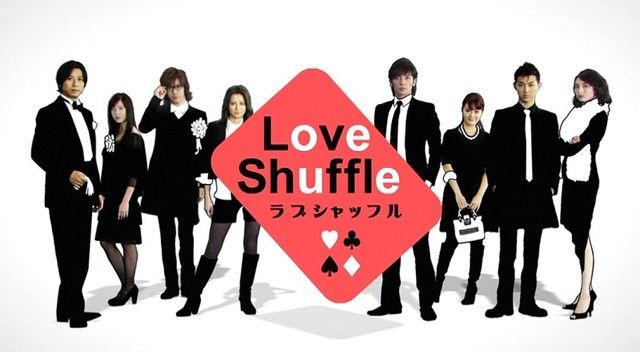
After reading endless praise-worthy reviews, and reading the synopsis, Love Shuffle seemed to be offering up something unique.  Four strangers who live on the same apartment floor meet one day in a stalled elevator, and after this plus a few other chance meetings, decide that each of their respective love lives are something of a mess.  Borrowing their own partners, they devise the ‘love shuffle’.  Each week a different couple is paired together, compatibility and chemistry are measured, true and fake loves abound, and everybody seems more confused about their destined partners than when they started.  It’s a true OTP-guessing drama, fun and sexy, with a healthy dose of quirky characters and plot twists.  All that, and I still couldn’t love it. 
"Say it ain't so.. Joe!"
Maybe I’m hung up on the idea that there is, or should be, something wrong fundamentally with casually switching partners every week.  Or maybe this is too much fiction for me to be able to accept that a psychiatrist would really put his suicide-prone patient into the mix.  Not that these are even serious flaws for a TV drama, but something from the get-go was telling me, “I don’t like it.” I nearly dropped the show at only two episodes.  A week later, and after some serious consideration, I picked it up again. 
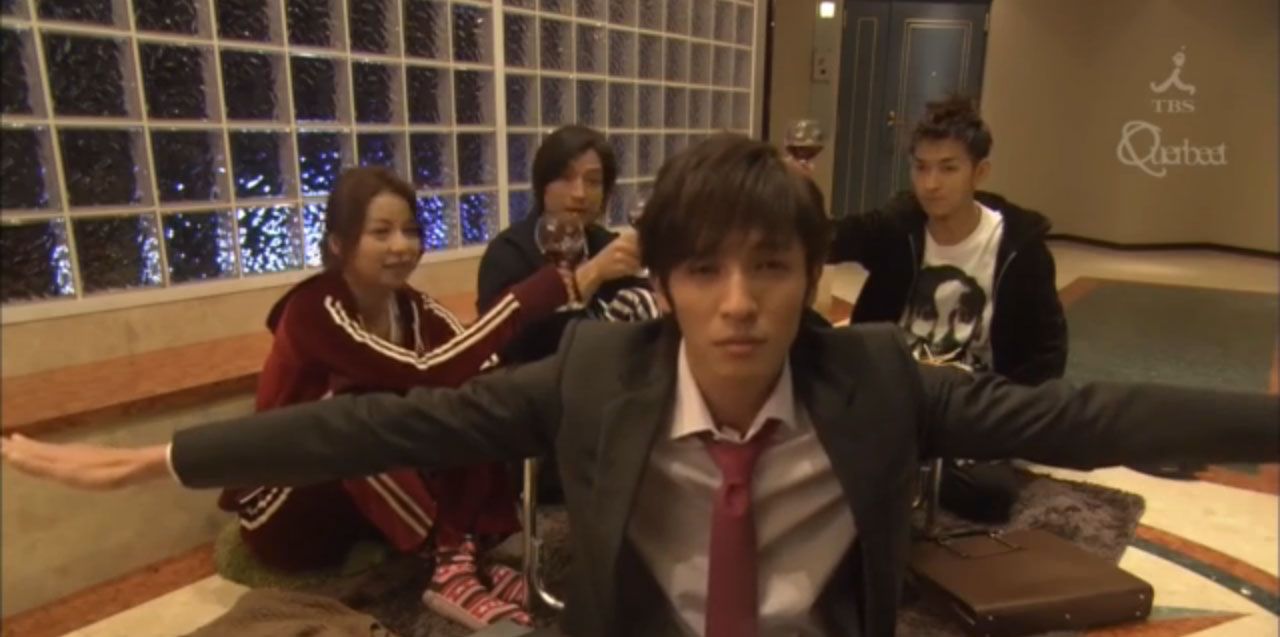
I’m happy I did so, because there are good themes to this drama.  For one, it doesn’t hurt to analyze what’s at the heart of a basic human relationship.  These are not your typical marriage-obsessed characters.  Indeed, some of them are quite the reverse, and some don’t seem to care one way or the other.  In Kdramaland, everything seems to scream of that one fated lover.  Miss your OTP, and you might as well resign yourself to a lonely, sad existence.  Here is where Love Shuffle breaks a few boundaries.  These are human beings yearning for one other, yes, but not necessarily or exclusively via typical romantic outlets.  If I loved anything about this drama, it’s in the friendships that were forged and honed throughout.  The foursome that live on the same floor, drinking wine each evening in the hall in their PJs.  The women who come together, alternately snarky and supportive.  The men who bond both in jealousy and in commonality.  The couples who are not destined, but can still inspire. 


Where I think Love Shuffle misses the mark though is in the fairly grey area of delivery.  It’s as if the drama can’t decide if it should be a comedy or a melodrama, an inspirational tale of life over death, or a social commentary of the emasculated young male figure in a patriarchal country.   Sure, the drama tries to tackle some issues in fairly creative ways.  The most relevant would probably be Matsuda Shota’s character Sera Ojiro, introduced to us as a former wartime photographer who had become disgusted at his own insensitivity. In a turnaround moment, Ojiro purposely starts a fight with a gang of men, who had just the day before beaten him senseless. Reinvigorated, he knocks down the greatest offender, looks around with satisfaction, and then calmly snaps a picture of the man’s bloody face.  
Not that I’m making too much of this parallel (or am I?), but Ojiro is also adept at using his camera to maneuver his models into the exact position and level of vulnerability he wants them in. 
Exhibit A:

Exhibit B:


Love Shuffle is commendable in its uniqueness, and multiple-plot driven storylines. It's even at times hilarious, though be sure to watch with decent subtitle translations, as oftentimes the jokes are Japanese-specific. I’m not sure why, but every now and then I find myself walking around thinking, “Yay, panda...” Sadly, that’s about as much enthusiasm I had overall, though that is not meant to be a discouragement.  I thoroughly recommend Love Shuffle, as I don't doubt that I am one of the few people out here too picky for my own good. So what do you think?